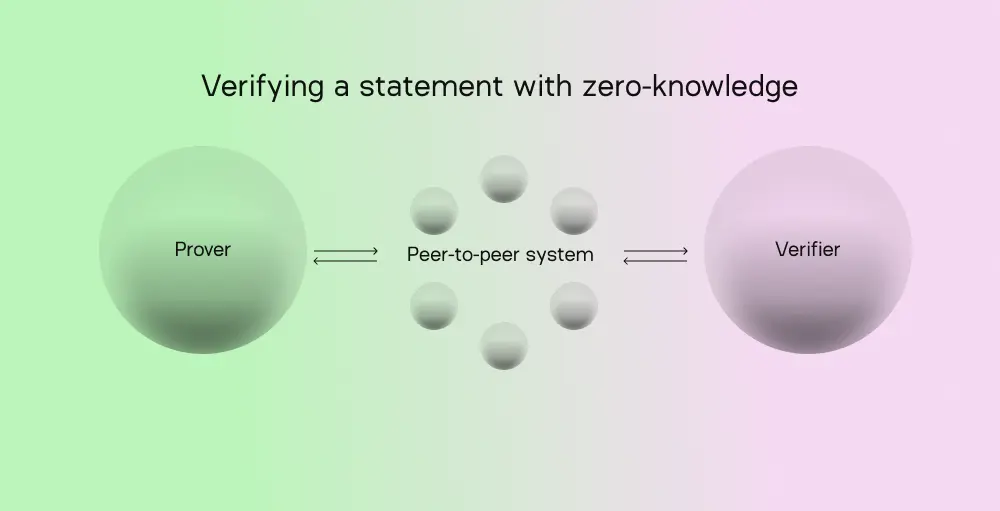
SNARKs and zk-SNARKs might sound like mythical creatures, but they’re actually among the most powerful cryptographic inventions of our time. These proof systems let one party prove knowledge of something, say a secret key or transaction without ever revealing the data itself. In this guide, we’ll demystify how they work, explore their building blocks like polynomial commitments and Plonk, and see why they’re essential to privacy and scalability in blockchain networks.
What Are SNARKs, Really?
Before we get too deep into math, let’s pin down what a SNARK is. SNARK stands for Succinct Non-interactive Argument of Knowledge.
It’s a cryptographic proof system that allows a prover to convince a verifier that they know a secret solution to a problem without revealing that secret sing a tiny proof that’s fast to verify.
In other words, instead of sending the entire computation, you send a short proof that says, “I did the computation correctly.”
For example:
“I know a message m such that SHA256(m) = 0.”
The verifier doesn’t need to see m or recompute the hash. They can check the proof almost instantly.

This structure makes SNARKs invaluable for systems that need trust without transparency like blockchain privacy layers and decentralized computation.
zk-SNARKs: Adding Privacy to the Mix
The “zk” stands for zero-knowledge, which means the proof leaks nothing beyond the fact that the statement is true.
So, a zk-SNARK is a SNARK that’s also zero-knowledge. It’s the difference between saying “I know the password” versus actually showing it.
In zk-SNARKs, the proof convinces the verifier that the prover knows the correct secret input (the “witness”) for a certain computation, but doesn’t expose any details of it.
Applications include:
- Zcash – private transactions on public blockchains.
- Aleo – private decentralized apps.
- Rollups (zk-Rollups) – scalability with validity proofs.
- Proof of solvency – exchanges prove they hold funds without revealing user balances.
Breaking Down the Core Components
To understand how SNARKs work under the hood, let’s look at their foundational layers.
1. Preprocessing Argument Systems
At the heart of a SNARK is an arithmetic circuit a mathematical representation of a computation. This circuit uses addition and multiplication gates over a finite field to encode logical or cryptographic operations.
Setup Phase:
-
A setup algorithm ( S(C) ) takes the circuit ( C ) and generates two sets of parameters:
- ( Sp ): for the prover
- ( Sv ): for the verifier
These parameters help both sides communicate securely and efficiently.
Proof Phase:
- The prover uses ( Sp ), the public input ( x ), and secret witness ( w ) to produce a proof ( π ).
- The verifier uses ( Sv ), the same ( x ), and the proof ( π ) to check validity.
If the statement is true and correctly computed, the verifier accepts.

This structure keeps computation heavy on the prover’s side, but lightning-fast for the verifier.
2. Polynomial Commitments: The Backbone of SNARKs
SNARKs often rely on commitment schemes cryptographic “envelopes” that hide data but can be checked later.
A polynomial commitment lets the prover commit to a polynomial ( f(X) ) without revealing it. Later, they can prove that ( f(u) = v ) for specific ( u, v ) values without exposing the full polynomial.
The KZG Commitment (Kate-Zaverucha-Goldberg, 2010)
This is one of the most widely used commitment schemes in SNARK systems.
It’s efficient because:
- The proof size is constant (independent of polynomial degree).
- The verification time is logarithmic.

While KZG commitments are elegant, they require a trusted setup, which introduces security considerations. Systems like Dory and Dark later replaced trusted setups with transparent alternatives.
3. The Interactive Oracle Proof (IOP) Layer
SNARKs become efficient by combining polynomial commitments with interactive oracle proofs (IOPs).
In an IOP, the prover commits to several polynomials, and the verifier can query random points to check correctness. To make this non-interactive, cryptographers apply the Fiat–Shamir heuristic, which replaces random challenges with deterministic ones derived from hashing previous steps.
Together, these elements make proofs:
- Short
- Efficient to verify
- Zero-knowledge compatible
4. Plonk: A Practical zk-SNARK System
One of the most influential modern SNARK frameworks is Plonk (Gabizon, Williamson, Ciobotaru, 2019). It’s a polynomial IOP designed to efficiently verify complex circuits.
Plonk turns circuit constraints into polynomial relationships and proves their correctness through polynomial commitments and zero-tests.
High-Level Flow of Plonk

Each constraint addition, multiplication, wiring, or output becomes a polynomial identity. The prover shows that all these hold true using zero-tests and product-checks on specific subsets of the polynomial domain.
Plonk has some killer advantages:
- Constant-size proofs (~400 bytes)
- Fast verification (~6 ms)
- Support for lookup tables via Plookup
- Suitable for zk-Rollups, Aleo, and other scalable systems
Real-World Applications of zk-SNARKs
1. Private Transactions (Zcash, Tornado Cash)
Users can prove they own tokens or made valid transfers without revealing addresses or amounts.
2. Scalable Rollups (zk-Rollups)
Layer 2 scaling solutions like StarkNet and zkSync use zk-SNARKs to compress thousands of transactions into one proof, massively cutting costs and improving throughput.
3. Proof of Solvency
Exchanges can show they’re fully collateralized by proving a cryptographic statement about reserves, without exposing any private balances.
4. Regulatory Compliance
zk-SNARKs make it possible to prove tax compliance or KYC status without revealing sensitive identity data.
Challenges and Research Directions
While zk-SNARKs are revolutionary, they’re not perfect:
- Trusted setups can be a risk if not performed securely.
- Prover computation can still be heavy.
- Quantum resistance remains a concern for future cryptographic security.
Current research is focusing on:
- Transparent setups (no secret randomness)
- Faster prover times (via parallelization and recursion)
- Post-quantum secure SNARKs
Projects like Halo 2, Nova, and SuperNova are taking these improvements even further.
Key Takeaways
- SNARKs = short, efficient proofs of knowledge.
- zk-SNARKs = SNARKs that also preserve privacy.
- Polynomial commitments and IOPs make SNARKs fast and scalable.
- Plonk and KZG are core frameworks powering modern zk-systems.
- These technologies are reshaping blockchain privacy, scalability, and trust.
Want to Go Deeper?
If you want to dive into the technical side, check out:
- Zk Hack Whiteboard
- Dan Boneh’s Cryptography Lectures
- Plonk Paper (ePrint 2019/953)
- Zcash Protocol Specification
Final Thoughts
zk-SNARKs have transformed the landscape of digital privacy and blockchain security. From enabling private payments to scaling networks like Ethereum, they’re a cornerstone of the next generation of cryptographic innovation. And as systems like Plonk, Halo, and Nova evolve, we’re inching closer to a world where trust and privacy can truly coexist.